In 2024 the United States and the European Union together added 39 percent of global GDP (2015 $). China was second at 19 percent whilst India lagged at 3.5 percent. Together these four economies added 62 percent to global GDP. Incredible as it might seem, in the short span of thirty-six years, by 2060- within the life span of anyone finishing school this year- the composition of global economic power could change radically with India replacing China as the growth leader.
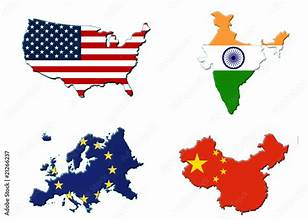
India, the growth leader amongst the front leaders – US, China, EU
Assume the world continues to grow, like it has since 1960, on average at 3 percent per year (real terms). By 2060 a growth of 3.5 percent per year gives ageing China a share in global GDP of 22 percent, marginally behind the immigrant boosted US economy, growing at a resilient 3 percent per year to a share of 23 percent. India growing at a relatively high 6.5 percent could have a share in global GDP of 10 percent, marginally behind the share of 11 percent for the EU, growing at a sedate 2 percent. Together the four economies could add 67 percent to global GDP in 2060, a larger share than the 62 percent in 2024. This aligns with the trend, since 1989 of concentration of economic power in these four economies. Their combined share in global GDP increases from 57 percent in 1989 to a projected 67 percent in 2060.
Wolfpack competition is more likely than cooperation
If economies were rational entities and inherently collaborative, rather than competitive, these four would club their resources to leverage growth within themselves. But political economy factors – leaders jostling for global dominance, pandering to domestic political dictates, posturing to appear more in control of global events than is possible for any one individual- all make geopolitics volatile beyond the capacity of any one country to derisk, think flashpoints like the Russo-Ukraine and the Israeli- Gaza war, driven primarily by the obduracy of the concerned leaderships.
India the underdog today
Sadly, of the four economies considered here, India is the most sensitive to geopolitical risks for two reasons. First, historically, India has invested insufficiently in consolidating support within its near neighborhood. To be sure we made grand conciliatory gestures like supporting China’s entry into the Security Council in 1949. With the US solidly behind China’s inclusion, there was little choice. But why did we not extract a price from China for that favor, like settlement of our border disputes, in exchange for abandoning institutional privilege in the United Nations?
Second, India ignored building a common regional strategy for global alliances, aiming instead for global leadership of the developing world at Bandung 1955. Privileging global media attention over quiet, transactional settlement of bilateral or regional interests and disputes has been an Achilles heel, which persists. India has chosen to remain excluded from the two major trade agreements in Asia – the RCEP and CPTTP- illustrating a delusion that India is big enough to work things to its advantage from the outside. It also overlooks the fact that India lacks the institutional capacity (sustained international engagement by non-transferable, subject experts, is one such) to shape decisions to its advantage, from the inside of such plurilateral agreements.
Nevertheless, with India clocking the highest growth rates in the post Covid years, despite the handicap of a higher bureaucracy, permanently in flux and distracted by the demands of engineered social fragmentation for political gain (a misguided foreign template), new opportunities for integrating better into global and regional partnerships shall present themselves, if we hang onto our key asset today – high economic growth.
India remains institutionally infirm for global leadership
Does India’s programmatic architecture reflect sufficient attention to promoting high growth, the key ingredient for global attention? The answer is a qualified yes. India displayed skill and courage in using fiscal expansion to overcome the economic ravages of the global financial crisis in 2008, unforced policy errors (demonetization in 2016) and the covid epidemic in 2021 and skill in protecting tax revenue. But actions to implement deep reform remain prisoner to the feared, negative political economy consequences from impacted vested interests.
Vested interests hold sway over majority interests
The middle class enjoy low property tax rates relative to land prices, free or cheap electricity and water, free bus rides for women and cheap rail travel. Privileged, large private corporates benefit from import protection and access to deliberative government fora. Many in the sizable public sector (banks, manufacturing, and utilities) are zombies- unviable enterprises. Low productivity government servants enjoy inflation indexed salaries, timebound promotions, untaxed perquisites, and housing. Rich farmers access free electricity, irrigation water, cheap fertilizers and pay zero income tax, whilst hiding behind the deprivations of small and marginal farmers (average land holding 1.4 to 0.4 hectares) who account for 80 percent of the farming community.
Coasting along is China’s gameplan, not sufficient for India
Despite the long list of pending structural reforms to weed out low productivity, it is possible to coast along at an annual real growth rate of about 6.5 percent per year by fiddling at the edges to extract more efficiency from fiscal outlays and enhance revenues through better tax assessments and savvy tax levies. But this is insufficient to push growth to 8 percent per year over the next thirty-six years to 2060. Why is this necessary?
India must acquire a critical mass in fiscal resources, infrastructure, and skills to compete in a tough neighborhood like Asia, where China poses an existential economic and security threat. The travails of Taiwan are an early warning. GDP is a reasonable proxy for economic heft, political muscle, and military capability. China’s GDP at $18 trillion (2015 $) is about 6X of India at $3.4 trillion (2024). Catching up with China requires maintaining a growth differential of 4 percentage points per year (real terms). Post the Covid downturn, the growth differential is about 2 percentage points in India’s favor. Future near parity in GDP is possible but only under optimistic assumptions. First that China’s growth will remain lukewarm at 4 percent (real terms) slowing to 3.5 percent per year and secondly, India shall grow at 7 to 8 percent per year over the next thirty-six years till 2060.
For the next four decades avoid self-goals and keep your eye on the ball
It is not inconceivable that democratic India, with the largest young population and locational advantages in fast growing Asia, could pick up the baton from a faltering China and drive future global GDP growth. By choosing an ill-timed, acrimonious, in-your-face path to perceived global dominance, China has gifted to India, the opportunity to become the “other,” more reliable, big economy offering the world a market with the fastest growing purchasing power, globally compliant institutional processes and standards and competitive suppliers. If we fail, we can only blame ourselves.
A previous version appeared in Asian Age on July 29, 2024 https://www.asianage.com/opinion/columnists/sanjeev-ahluwalia-securing-indias-future-can-we-replace-china-1812813

 Opinion India