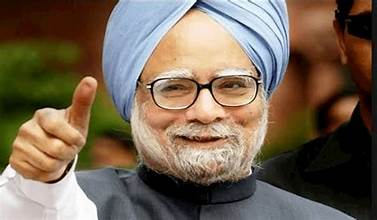
Dr Manmohan Singh breathed his last on December 26, 2024. Finance Minister of India 1991-1996 and Prime Minister of India from 2004-2014 he was cremated on December 28.
Four attributes distinguish Dr Manmohan Singh (India’s thirteenth Prime Minister (2004 to 2014) from his predecessors and his sole successor- Narendra Modi.
A bureaucrat and a politician
He was the second Indian Prime Minister, after Morarji Bhai Desai (in office during 1977-1979), who successfully made the transition from the bureaucracy to politics. His first task was as Minister of Finance in 1991 curating the economic reforms and liberalization strategy, for an India, at the time, on the brink of default and then in 2004 as Prime Minister.
A globally competitive professional PM
Second, with significant professional credentials as a working economist – a college professor, Chief Economic Advisor in the Union government and Governor, Reserve Bank of India, he brought to political office, globally acknowledged intellect and professional skills. All other Prime Ministers have been professional politicians, except Rajiv Gandhi, who was a commercial pilot before the untimely assassination of Prime Minister Indira Gandhi, his mother, induced him to stake his claim to the Nehru-Gandhi political legacy in 1984.
A Sikh as PM
Third, he was the only Sikh Prime Minister though Giani Zail Singh had been President of India earlier(1982-1987) – a largely ceremonial job in India, Sikhs are a minority community in India less than 2 percent of the population but traditionally well integrated with the majority community of Hindus, till the assassination of Indira Gandhi by Sikh militants in 1984, which sparked revenge pogroms on Sikhs by errant sections of the Congress party.
Mild mannered but determined.
Fourth, mild mannered, courteous and of an accommodating nature, he was both from the ideological “big tent” of the Congress party and yet removed from its hurly burly and vacuousness by his dual personal allegiance to follow the politically least cost path subject to it being a technically kosher option. Once convinced of the technical and political merits of a strategy he was determined in its pursuit – the civil nuclear deal with the US being one example, to the chagrin of Communist allies.
Unelectable but unbeatable too
He was less a political strategist than an economic policy maestro -fine tuning programs to Indian aspirations with an uncanny charm and an eye to the big chance. His only attempt at getting elected from a New Delhi constituency was unsuccessful as he was unmindful of his lack of support within the local Congress party who resented a shoo-in with top leadership support. This casual approach also sprung from the knowledge that the Congress party was sure to accommodate him as an MP via the Rajya Sabha route, where captive party members in state assemblies, vote for the party’s nominee, not unlike the quasi “democratic” elections in China.
The end of an era
Doctor Sahib’s passing on December 26th and the earlier June 18th, 2018, passing of Atal Behari Vajpayee – India’s much loved, poet PM (1998-2004) from the BJP, leaves just H.D, Deve Gowda Janata Dal PM during 1996-97 with us. An era has ended. The era of political leaders, who matured in the aftermath of Independence, lived through the early period of Congress dominance 1947-1977, followed by changing political destinies till 2000 when the first BJP led alliance government ruled for a full term followed by a Congress party led alliance governments for two terms 2004 to 2014 and finally a resurgence of BJP since 2014. It is the end of an era where politics was genteel, the electorate passively predictable and the world more static than it is today.
Courtesy, conviction, excellence as bye words
Doctor Sahib and his times will be remembered for courtesy being a bye word of inner strength, conviction a prerequisite for leadership and excellence a necessary ingredient for continuing success. Nevertheless, it is just as necessary to be mindful of the misses, more plentiful that the hits, that India achieved despite the heady political environment.
The list of woes
Growth improved but the fiscal deficit soared. The policy of easy credit introduced irresponsible lending and rising debt not accompanied by increasing debt servicing capacity. Good jobs remained in short supply even as social welfare schemes increased. The list of legally enforceable rights grew long even as access to these rights remained narrow. Agricultural productivity and manufacturing depth remained unsatisfactory.
Corruption was rampant and acceptable as “the dharma of coalition politics”. Instances where senior bureaucrats unfairly paid the price of institutionalized corruption, without a personal quid pro quo being established, merely as the “fall guys” of political decadence, shook the confidence of the steel frame and undermined whatever remained of its “do or die” spirit.
Looking ahead
Nevertheless, the big moments are still ahead, not behind us. It is time we choose the best from the recent past, junk aberrations to the Indian way of life and move to a sustainable and equitable future. One such is that we democratize our ruling elites. Till now every Prime Minister who passed on in Delhi was cremated at a special site in the vicinity of the ironically named “Raj Ghat,” where the man of the masses, Mahatma Gandhi was cremated. Prime Minister V. P. Singh was cremated in his home state at the holy Prayagraj where the Ganges and Yamuna merge. Morarji Bhai Desai died and was cremated in Mumbai.
The only exception till now was Dr Manmohan Singh’s senior colleague in liberalization, Prime Minister Narasimha Rao who died in Delhi in 2004 (when Dr Singh was the Prime Minister). He never found a resting place in Delhi and his remains had to be evacuated to Hyderabad for the last rites.
As luck would have it, even Dr Manmohan Singh has not been accommodated in the Raj Ghat vicinity and was cremated at the publicly available Nigam Bodh Ghat in Delhi- thereby becoming the first PM to have thus been laid to rest. Conspiracy theorists would see in this aberration a political plot. The Akali Dal Party has fingered the BJP for discriminating against Dr Singh because he is a Sikh. This seems at best a political ploy. Dr Manmohan Singh by his actions and his speech always took pride in being a human being first and an economist next. Such was his calibre that he never needed to play the minority card to get ahead. Looked at another way, this is a welcome step. For far too long, we have eulogized those in high office and cosseted them with special benefits, quite contrary to the democratic spirit, which distinguishes respect from blind devotion.
It is the fate of all humans to die eventually. It reeks of elitism to have a specially dedicated place for the elite to be cremated which is then converted into a “memorial” to them and closed for public use. Near the Raj Ghat, nine previous Prime Ministers occupy such publicly maintained, personal memorials. The last PM thus honoured was Prime Minister Atal Behari Vajpayee in 2018.
It might be time end this practice for ever. Economic liberalization and downsizing statism are still not the gut instinct in India though the lived experience is making it a habit if not a necessity as Doctor Sahib would want it to be. This is an idea whose time has come- and if Doctor Sahib and Victor Hugo are to be believed- no power on Earth can stop it.
——————————————————————————————————————
________________________________________________________________________________________________________

 Opinion India