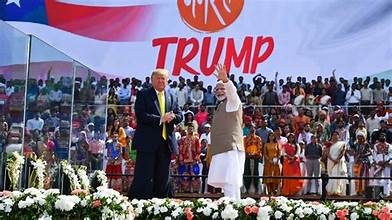
Uplifting tailwinds, inspired by personal chemistry, boosted America-India friendship to unprecedented levels in the public imagination, via two never-before joint, public events – “Howdy Modi” in Houston, 2019 when Modi called the 2020 US election for Trump. The resultant bond of friendship was sealed by “Namaste Trump” in Ahmedabad, India early in 2020. But it was not to be. Thereafter the relationship leveled off to more normal, but warm levels under President Biden. That is history, now that President elect Donald Trump will be back as POTUS in January next year. Four factors drive the expectation that India-US ties can only get stronger.
Doing it my way
First, America edged closer to India by ignoring the advice given by twenty-seven Nobel Prize winning American economists that Kamala Harris would be a better steward of the economy than Trump. Indians have a similar disregard for economic advice, which whilst being well-meaning remains too theoretical and deeply hedged with “on the one hand and on the other hand” escape clauses, to be of practical use. Leaders reflect their voter biases. No wonder then, that both Prime Minister Modi and President-elect Trump share a “business-like” world view, impatient with the constraints of history, political philosophy, economics, or ideology- through neither is averse to getting their contextually derived action plans endorsed by ideologs- if the two converge. Getting something done in the near term is the core motivation for both leaders.
Neither leader was a foot soldier of the party they lead. Trump burst on the political scene as a leader with no prior political experience in 2016. Prime Minister Modi, though a child of the Rashtriya Swayamsevak Sangh, is the perpetual “insider-outsider” who marches to his own tune. He became Chief Minister of Gujarat in 2001, without ever being a member of the legislative assembly previously. He shone by orchestrating L.K Advani’s 1990 Rath Yatra mobilizing Hindu support for a Ram Temple at Ayodhya – an aspiration, now fulfilled, earlier this year. Both Trump’s America and Modi’s India are unmindful of treading on established conventions to suit short-term national interest. In this they differ from China’s Deng Xiaoping only in playing to a shorter planning horizon.
Managing China
Second, managing the growing Chinese threat to the established global order is a common goal albeit with differing intent. Maintaining global dominance is to the benefit of America. India is a new, aspirant to global power aiming to bend global rules to its own benefit, in the medium term. In the short term its objectives are complex, mirroring America’s, in seeking to moderate China’s bellicosity, whilst continuing to profit from China’s highly skilled workforce, malleable domestic regulations for foreign investment and competitive exports selectively. The US is India’s biggest export market, but China is the biggest import partner. If India succeeds in becoming a global hub for technology design and services, it can meet the demand of American and European consumers by using the manufacturing smarts of China in India. China is ageing and in a weak fiscal spot presently, which could defer its dream of global hegemony to beyond 2045. Trump and Modi could work this to their mutual benefit by engaging with China to refocus its energies on development rather than strategi autonomy. Why jump the gun by two decades? China is yet to become a high-income economy per the World Bank Atlas method for computing average per capita income in $PPP.
Realpolitik dominates
Third, neither Trump nor Modi worry overly about the ideological virtues of democracy, a system which, ironically, elevated them to leadership. For both, as for Mao Zedong, all cats are good if they catch mice. Functionality is the key. China has never experienced democracy based on multiple parties, universal suffrage, and citizen rights. But a significant majority of citizens across these three countries remain deeply attracted to democratic principles of equity. Neo-capitalism (regulated markets with property rights or party guided capitalism Chinese style) is the global growth meme. The inevitable downside is inequity in the distribution of wealth and income. This requires global solutions for safeguarding individual rights against corporates and the State. At first sight, there is nothing common between the US and India or China. But there is a reason Indian and Chinese immigrants to the United States do so well.
On reaching that “shining place on a hill” they fit right in, because the US is a melting pot, like India, except that it is on efficiency steroids and minus the hassles of a growth suffocating bureaucracy. The extensive welfare programs funded by the Modi government (and imitated by competing parties in state governments, sometimes called “freebies”), are mood elevators to dull some of the pain of transition from a low efficiency economy to a high value-addition economy where social customs, norms, ritual status and individual needs are all subject to the imperative of putting commitment to work above all else. Like the US, China privileges corporate interest above worker interest. India is yet to get there.
Long term complementarities
Finally, the intervening three decades from 1970 to 1990s were an aberration, book ended by collaboration with the US. The Kolkata based Damodar Valley Corporation was established in 1948 as the first multi-purpose river development project, modeled on the Tennessee Valley Corporation in collaboration with American engineers. In the 1960s America responded with food support to tide over two successive droughts in India. Actions speak louder than words, even if the relationship cooled over the subsequent three decades till 2008, when India’s access to the club of civil nuclear power suppliers was facilitated by the US.
Published in the Asian Age November 15, 2024. https://www.asianage.com/opinion/columnists/sanjeev-ahluwalia-trumps-america-poised-to-move-much-closer-to-india-1838308

 Opinion India